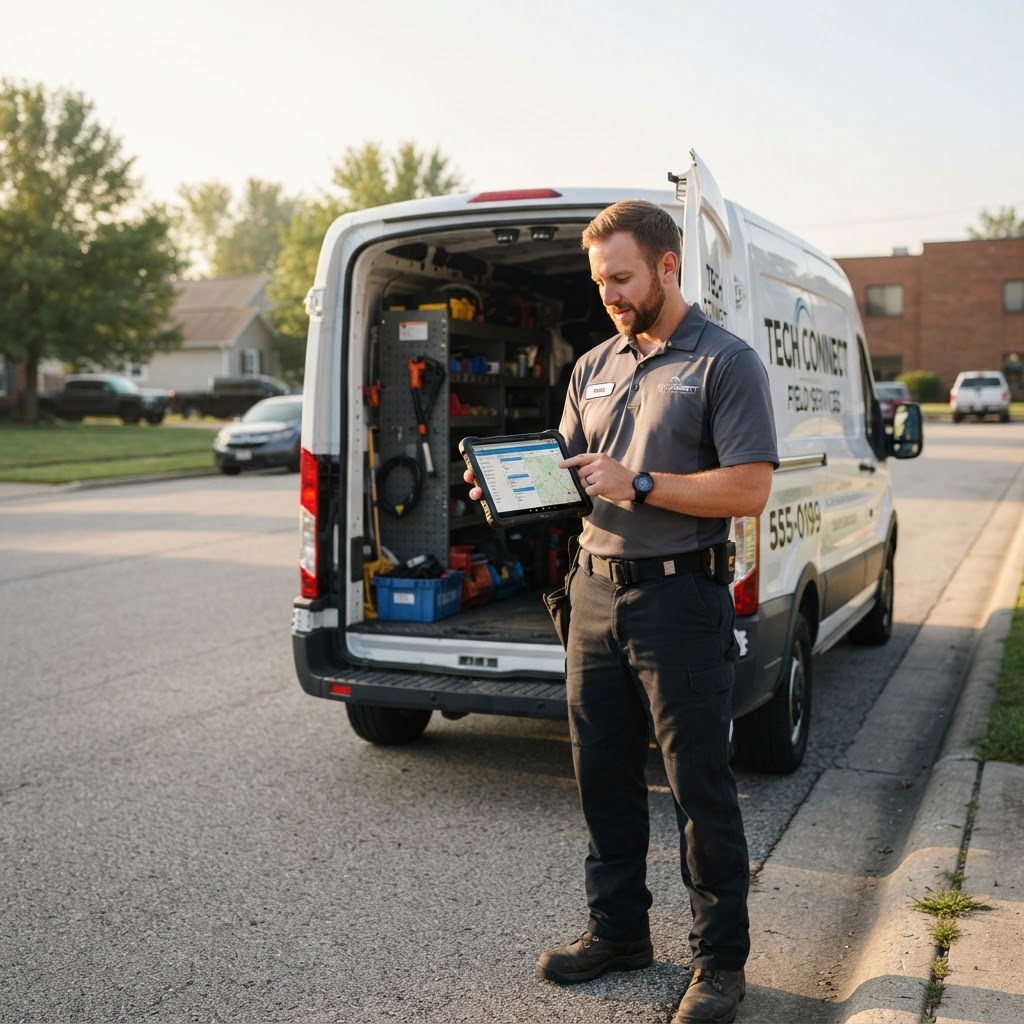
Busy crews and slow receivables can coexist—and that combination stresses owners more than almost any other ops problem. You finished the work. The customer is happy. The money is still sitting in "I'll pay you Friday."
Busy crews and slow receivables can coexist—and that combination stresses owners more than almost any other ops problem. You finished the work. The customer is happy. The money is still sitting in "I'll pay you Friday."
Strong field service invoicing is not aggressive collections theater. It is a clean process: invoice quickly, make payment easy, track what is pending, and follow up consistently. Below are practical best practices home-service businesses use to get paid faster without damaging relationships.
Why contractor invoices stall
Before changing tools, diagnose the delay points:
- Invoice lag — work finished Friday, invoice sent next Wednesday.
- Unclear scope — customer disputes line items that were never written down.
- Hard payment path — check-only, no portal, no card link, vague "mail it in."
- No aging visibility — nobody knows which invoices are 15 vs. 45 days old.
- Inconsistent follow-up — reminders depend on the owner remembering after dinner.
Cash flow improves when invoicing becomes part of job completion—not a weekend admin chore.
Best practice 1: Invoice as close to completion as possible
Same-day or next-morning invoicing consistently beats batching everything at month-end.
Make "done" include "billed"
Define job completion as:
- Work documented (notes or photos if needed)
- Materials and extras captured
- Invoice created and sent (or scheduled to send)
- Status updated so the board reflects reality
For route businesses (pool, lawn, pest), bulk-generate invoices for a completed route day instead of recreating each one by hand. The goal is minutes per day of billing—not hours of retyping.
Capture extras in the field
Change orders and truck-stock parts disappear when they live only in a tech's memory. Train the team to log extras before leaving the driveway. Your invoice accuracy—and your margin—depend on it.
Best practice 2: Write invoices customers can understand in 30 seconds
Confused customers delay payment. Clear invoices speed it up.
Include on every invoice
- Your business name and contact info
- Invoice number
- Customer name / service address
- Job date and short description
- Line items with quantities and rates
- Taxes (if applicable) and total due
- Due date and accepted payment methods
- Remittance instructions or pay link / portal reference
Price presentation tips
- Prefer plain-language line items ("Quarterly HVAC tune-up – outdoor unit + filter check") over internal SKU codes alone.
- Separate labor, materials, and trip fees when that matches how you sell.
- If you quoted earlier, mirror the quote structure so approval and invoice feel like one conversation.
Best practice 3: Set terms—and actually use them
"Due on receipt" means nothing if you never follow up. Pick terms that match your trade and stick to them.
Common patterns:
- Due on receipt / Net 7 for residential one-off repairs
- Net 15 for larger residential projects
- Net 30 only when commercial accounts require it—and price accordingly
- Deposits + progress billing for installs and renovations
Put terms on the quote and the invoice. Surprises create disputes; disputes create delays.
Deposits protect cash and commitment
For bigger tickets, collect a deposit before ordering equipment or blocking multi-day crew time. Progress invoices at milestones beat one giant bill at the end that the customer "needs to review."
Best practice 4: Make paying easier than ignoring you
Every extra step is a reason to postpone.
Practical accelerators:
- Accept cards and ACH where it makes sense (know your fees; price them into jobs if needed)
- Offer a customer portal or pay-by-link experience
- Send invoices by email and SMS when appropriate
- For recurring accounts, discuss autopay or on-file payment methods
- Keep your remittance details identical across every invoice
You are not "being pushy" by removing friction. You are respecting both sides' time.
Best practice 5: Run a weekly receivables rhythm
Owners who get paid faster usually protect a weekly 20–30 minute money block:
- Filter pending / overdue invoices.
- Segment by age (0–7, 8–14, 15–30, 30+).
- Send polite reminders for early aging.
- Call for older balances or high-dollar items.
- Pause new non-emergency work for chronic non-payers (policy, not mood).
Reminder tone that works
Keep it factual and courteous:
- Day 1–3 after due: friendly nudge plus pay link
- Day 7–10: firmer note referencing invoice number and due date
- Beyond that: phone call; document the conversation
Automating early reminders helps. Human judgment still matters for edge cases and long-term accounts.
Best practice 6: Connect quotes, jobs, and invoices
Retyping pricing is how mistakes—and awkward customer conversations—happen.
A cleaner lifecycle:
- Quote with clear line items
- Convert approved quote → job (scope and price travel with it)
- Complete job with notes / extras
- Generate invoice from the job
- Track paid vs. pending in one list
When those steps share one customer record, your office spends less time reconciling "what did we say we'd charge?"
Best practice 7: Watch a few cash metrics
Skip vanity dashboards. Watch:
- Days sales outstanding (even a rough average)
- Pending invoice total vs. typical weekly revenue
- Percent invoiced within 24–48 hours of completion
- Reminder-to-payment lag
- Write-offs / disputes (quality signal for quoting and notes)
If pending invoices grow while jobs look "busy," you have a billing process problem—not a sales problem.
Policy ideas that protect the business
Put these in writing (and train the team):
- When deposits are required
- When work pauses for overdue balances
- How change orders are approved
- Who can discount or write off
- How warranties and callbacks are billed (or not)
Consistency feels fairer to customers than ad-hoc exceptions that depend on who answered the phone.
Where CrewField fits
CrewField ties customers, jobs, quotes, and invoices together so billing is a natural close to the visit—not a separate project. Owners can track pending invoices from the dashboard, bulk-generate after route-heavy days, and pair invoices with SMS reminders and a customer portal so payment does not require phone tag.
See how invoicing connects to the rest of the job cycle on the features page, or review the simple flat pricing if you are ready to stop chasing paperwork on Sundays.
30-day invoicing upgrade plan
Week 1: Define completion = documented + invoiced. Clear your backlog of unbilled finished jobs.
Week 2: Standardize invoice template and payment methods; add due dates everywhere.
Week 3: Start a weekly aging review with a simple reminder sequence.
Week 4: Tighten quote→job→invoice handoffs; measure invoice lag.
You will not eliminate late payers entirely. You will shrink the pile that is late because your process was late.
Bottom line
Getting paid faster is mostly operational hygiene: invoice immediately, write clearly, set terms, remove payment friction, and follow up on a schedule. Do that consistently and cash flow starts matching the work your crew already completed—which is the whole point of running the business.